by Neil Kearney | Jul 22, 2011 | Featured, For Sellers, General Real Estate Advice, Real Estate 101
In order to sell a house in today’s real estate market a house must make a compelling case to the market. Some things like neighborhood and location within the neighborhood you can’t control. But set those aside and you are left with two key variables that are controllable and important to the sale.
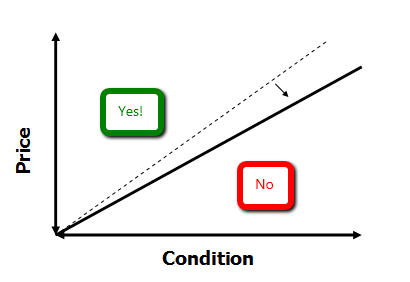
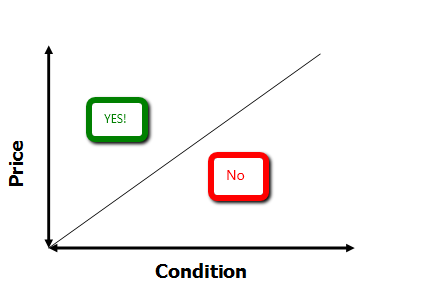
What I’d like to talk about today is being competitive in the market. The main variables a seller has control over is the price they ask for their home and condition and/or upgrades of the home. I have represented these two variables on an axis below so that I show you what I’m thinking. Basically, if your home is in great condition (and I mean exceptional) you can ask a high price compared to similar homes on the market. If your home is in poor shape you have to ask a lower price. This is not rocket science but it gets trickier when a house is somewhere between the extremes. It is in okay condition and has a middle of the road price. Looking at the chart below you can see the line running at 45 degrees. Think of this as the success line. Every house that fits above the line (price vs. condition) will most likely end up in a successful sale. Every home below the line will wallow until the price or the condition changes enough to get it above the line.

Right now the market is fairly slow. There are fewer buyers out there. This means that competition for sellers is tough. In order to be compelling to the small pool of buyers they have to bring a more compelling product to the market. This means that the line has shifted, sellers have to either improve their home to sell it for the same price or reduce their price to make it work.
Knowing where you are is the tricky part. I help my clients by giving good feedback and keeping them abreast of the market as it changes. The information you used to list your house is no longer valid. Get it priced right and have your house show the best it can. If you can’t afford to make improvements up front, lower your price. It’s simple economics.

by Neil Kearney | Feb 23, 2011 | For Buyers, For Sellers, Real Estate 101
You have probably seen the attached picture before – is it a picture of a young women or an old women? The answer is it depends on how you are looking at it. How you perceive it.

One definition of reality is: “all of your experiences that determine how things appear to you”. I agree with this on many levels – I believe you make your own reality and what you know and believe as well as your past experiences effect what is “real” for you. A slum dweller in India has a much different reality than a socialite living in Beverly Hills.
The key word in the definition above is experiences. I submit that this definition is not as true as it once was. Don’t worry, I will tie in to real estate in a moment.
In the past (B.C. through the 19th century), reality was based on what one actually experienced. All inputs to opinion were very localized. For example, when there was a famine, chances were that you were hungry. Perceived reality equaled actual reality. There were no outside forces to sway your perception.
During the last century, technology in all of its forms have provided us a wider set of inputs. I guess this is called globalization. We have access to and know more about more subjects. Where we used to just be concerned with our local experience, we now are fed data on an ever-broadening spectrum of subjects. Google (verb) whatever subject you can imagine and have instant access to other’s research and opinion’s. It is no longer our own experiences that form our perceived reality it is the experiences and knowledge of others.
My point is that our perceived reality may not always equal our actual reality due to the influence of non-localized information. I run into people all the time who can’t believe the sorry state of our real estate market. The problem is that they have no actual experience with the market, their perceptions are based on outside information. When people come in from out-of-town, (or locals who have not been paying attention to the trends) they assume that values have dropped at least 20%. When in fact they have remained relatively stable over the past 5 years. They come from that paradigm when they submit very low offers. It is easy for sellers to realize that these low ball offers do not fit with the market.
Right now, the media has plenty of negative news to report. There is blood in the water and the sharks are in a frenzy. Foreclosure’s in CA, value loss in Michigan, empty buildings in Florida, etc. Bad news all around, a fact. The problem is that people take that news and equate that news to all other areas. The message is that the market is bad, the conclusion is that the market is bad everywhere.
I get asked all the time what a reasonable offer would be. My answer depends upon many factors but hard data also helps bring a good perspective to the negotiations. Over the last year in Boulder County, real estate transactions have had the following average negotiation percentages in each price range:
$0 – $250k 3.15% (1,307)
$250 – $500k 2.95% (1,550)
$500 – $750k 3.99% (498)
$750 – $1 MM 5.24% (141)
$1 – 1.25MM 8.2% (58)
$1.25 – $1.5MM 8.35% (35)
$1.5 – $2MM 9.9% (22)
>$2MM 8.65% (23)
Numbers in parenthesis represent the number of sales in that price range.
Perception does not always equal reality. While the market in Boulder County is not stellar, it is much better than what you would think by listening to the news. Prices are holding, properties are selling and foreclosures are not a big part of our market. We are very lucky and I’m spreading the word! When you are ready to buy or sell give me a call. I’m here to help. Neil 303-818-4055

by Neil Kearney | Nov 15, 2010 | For Sellers, General Real Estate Advice, Real Estate 101
I get calls all the time asking for advice on whether it would be smart to do a particular remodeling project around their home.  Many times it is tough for me to make the call for them. I look at houses all the time and see what buyers like but in most cases improvements don’t pay off right away. For instance according the Remodeling Magazine’s Cost vs. Value Report 2010-2011 a two story addition in the Denver area will cost $155,903 and give added resale value of $118,301. This means that an owner could expect to get about 76% of the value out of that project. Not exactly a strategy from the pages of Trump – The Way to the Top.
Okay, we have established that you won’t get back all of your money if you do a home project but what if that scares you into paralysis? Say you have owned your home for 15 years and during that time you have done nothing but change the filters in the furnace. This strategy, in my opinion works even worse than improving your home right before closing. In the case of the do-nothings, the value of their home will lag behind the neighborhood in general. Their home will stay on the market longer and in the end sell for a lower price. Again not a way to get rich quick.
I think the best strategy for maximizing the value of your home over time is to make incremental changes over time. Take on a project every six months or 1 year. For example, take a six month period to remove the old wallpaper and repaint. Next, re-do the powder room by removing the wall sized mirror and replace with a framed mirror and replace the lighting. Next re-tile the master bath. After a few years your house will start looking refreshed and will be one of the nicer ones on the block. And when you go to sell it you won’t have much to do to get maximum value. Also, you get to live in a much nicer home. Not just fix it up for someone else. There is value in that!
Here is a sample of the value of Midrange projects and their pay back in the Denver market:(ranked in order of pay back percentage):
- Garage Door Replacement – cost $1,228 – cost recouped 93.1%
- Steel Entry Door Replacement – cost $1,165 – cost recouped 86.1%
- Minor Kitchen Remodel – cost $21,035 – cost recouped 79.6%
- Vinyl Window Replacement – cost $10,330 – cost recouped 77.1%
- Wood Deck Addition – cost $10,721 – cost recouped 75.1%
- Major Kitchen Remodel – cost $53,032 – cost recouped 73.5%
- Master Suite Addition – cost $100,775 – cost recouped 74.5%
- Family Room Addition – cost $79,383 – cost recouped 70.6%
- Basement remodel – cost $62,115 – cost recouped 63.2%
- Roofing Replacement – cost $17,943 – cost recouped 61.8%
For copyright reasons I can’t display the report on my website but if you would like a copy of the full report which includes midrange and upscale projects and defines the scope of each please let me know. I can send you one if you request one to neil@neilkearney.com.
To see the associated web page go here.
For more information this topic see my post on list price vs. condition.
From HGTV a before and after.
by neil kearney | Oct 16, 2010 | Real Estate 101
The recent fires have brought an interesting question to mind. Would you know exactly what you lost if you lost everything? Sure you would remember your TV and your car and your appliances and your bed. But would you remember the silver serving dish in the cabinet or what is on your storage shelves or every picture on every wall?
We make assumptions like our house will always be there when we return or that we would remember what we have. Well, both of these are just assumptions. Material possessions don’t rule my life but I wouldn’t want to be wracking my brain for six months trying to remember so here is a tip. Do a home inventory and store it somewhere safe.
I haven’t checked the security of it but I have found an online solution that can work in conjunction with photos and videos to keep track of your possessions. This will significantly speed up the time needed to settle an insurance claim and will help you determine if you have the appropriate amount of coverage. The site is www.KnowYourStuff.org and it is free. Check it out and just do it.

by Neil Kearney | Aug 11, 2010 | For Buyers, For Sellers, Real Estate 101
A recent advertising campaign had the slogan “Make sure your agent is a REALTOR”. The campaign was paid for and developed by REALTORS who wanted to differentiate themselves from those real estate agents who are not REALTORS. Still, I don’t think the public gets it fully. “Aren’t all real estate agents REALTORS?” the public may think. This is like saying “aren’t all colas Coke” or “isn’t all tissue Kleenex?
Currently there approximately 35,000 people in Colorado with a license to sell real estate. Of those people approximately 23,500 are REALTOR, meaning they are a member of the National Association of Realtors (NAR). So what is the difference and why should you care.
To start the explanation we go back to 1913 when The Code of Ethics (The Code) was first adopted by NAR. The Code is a document to which all REALTORS swear to abide by and be held to. The backdrop of the creation of The Code was an era of the fraudulent subdivision, the fake city addition, the multiple “first” mortgage, the “net” listing, and a myriad of other “get rich quick” schemes involving the sale of land.”1 It was a time before state regulations regarding real estate and the time when “buyer beware” really meant something. The Code was written on the premise that REALTORS should serve the public and being a REALTOR meant that you upheld a higher standard of business practices.
Nearly 100 years later The Code of Ethics is still going strong. It is a living document meaning that it is in a constant state of review and revision. Each year new interpretations and or Standards of Practice are added to The Code. It is as relevant now as it was 97 years ago.
The Code works because it includes both the ideals on which we should base our real estate practice and a mechanism for hearings, education and discipline where needed. The Code gives the public and our real estate peers a way to stand up for principle and make a stand for what is right.
The Code of Ethics is a document which includes 17 Articles organized under three main headings; ‘Duties to Clients and Customers’, ‘Duties to the Public’, and ‘Duties to REALTORS’. Each article is further explained by specific Standards of Practice which give clarification to the intent of the articles. The basis of all articles in The Realtor Code of Ethics is the Golden Rule “Whatsoever ye would that others should do to you, do ye even so to them”.
So what happens when in your opinion a REALTOR acts unethically? The public as well as fellow Realtors can file an ethics complaint with the local REALTOR association in which the offending agent is a member. There is then a pre-defined procedure in which the complaint is processed. The complaint is taken very seriously and is handled confidentially by a panel of peers. The first step is the Grievance Committee which determines if a hearing should take place. The Grievance Committee acts as a grand jury. If the complaint is determined to be valid, the next step is a full hearing which replicates a court of law. The outcome is not criminal but an offending REALTOR can be punished.
So, what does it matter if your agent is a REALTOR or not? Both are licensed and can help you buy and sell real estate but only a REALTOR has pledged to serve the public ethically and consistently, and is willing to be upheld to this standard by a panel of their peers. To me it is more than that. REALTORS have made a commitment to serve the public and to conduct business in a way that the public expects.
I am privileged to have been chosen to be the chairman of the Grievance Committe for the Boulder Area REALTOR Association this year. To me how business is conducted does make a difference.
To read The Code online click here.
1 – Article – “The Realtor’s Code of Ethics – A Gift of Vision, 1978 William D. North.

by Neil Kearney | May 25, 2010 | For Sellers, Real Estate 101
Deciding to sell your house is a big decision. Once you have decided to place your house on the market putting your houses ‘best foot  forward’ is one important step to getting it sold. Here is a link to an article which addresses this subject. Of course I’m always happy to come out and take a look at your house and let you know what I think needs to be done. In my experience you are much better off doing the work in advance than waiting for a negotiation with a buyer that might never come.
Visit houselogic.com for more articles like this.
Copyright 2010 NATIONAL ASSOCIATION OF REALTORS®