by neil kearney | Aug 13, 2025 | Boulder County Housing Trends, Uncategorized |
Yesterday, I showed the level of activity in our local real estate market by month. The result was a nice curve that peaked in June. Today I’m going to show the median closed prices by month. The chart below shows very little correlation between price and the month it sells. In my experience the time of year affects time on the market more than price.  As always, I’d love to be of service. Give me a call and I’d love to show you how your home fits into the local market.
by neil kearney | Aug 13, 2025 | Boulder County Housing Trends |
One of the best sources for broad market analysis are the companies that provide mortgage insurance. MGIC (Mortgage Insurance Guaranty Corporation) provides mortgage insurance nationwide. It is in their interest to know where the markets are going because it is their money that is on the hook if a mortgage is defaulted. In a market where values are rising they really can’t lose because as the value rises, equity rises, and as equity rises the risk of loss falls. On the other hand in an environment of stable or falling prices the risk of loss remains high over time.
So, I was interested to find that MGIC has on their website a Market Trend Analysis for the top 72 real estate markets in the country. It gives a summary view which states whether the current conditions are stable, soft or strong as well as a projection for the future. For example, Denver is currently rated “Stable” with “No Change” as the projection.
Who’s Hot and Who’s Not
Currently there are 11 markets or 15% that are rated “Soft”. These are mostly in the Midwest with the few exceptions being Miami, FL, San Jose, CA and San Francisco, CA. Conversely, there are currently 12 markets that are rated as “Strong”. Markets rated as “Strong” include Seattle, WA, Salt Lake City, UT, Tuscon, AZ, Washington, D.C., and five locations in Florida. This leaves the majority of markets around the country as “Stable”.
What I find even more interesting are the projections, are markets getting better or worse in general. Six markets are “Improving”. These include; Albuquerque, Austin, Nashville, Raleigh, San Antonio and San Francisco. There are 12 areas that are listed as “Softening” or “Weakening”. I think this represents the general fizzle of the markets nationally, which is a natural result of the strong gains in recent years.
The website then focuses in on each of the markets and gives a snapshot of income trends, employment, housing affordability, home prices from OFHEO, employment mix and household growth.
General Observations about Denver are as follows: “Denver’s economy has maintained a steady growth rate. Annual employment increased 1.7%, as the unemployment rate held int eh mid 4% range. The proposed redevelopment of Union Station and expansion of the light rail system provide for a positive outlook. Denver’s housing market is showing signs of slowing, but remains stable. The supply of single family homes increased to 7.2 month, with almost 65% of the sales in the $200,000 to $500,000 range. The supply of condominiums is now at 9.2 months, with 40% of the sales under $140,000. Steady population and job growth will help both the housing sector and the demand for office space.”
I will compare our outlook to some others in the coming days. Stay Warm!
by neil kearney | Aug 13, 2025 | Boulder County Housing Trends |
I mentioned a week or two ago the Mortgage Guaranty Insurance Corporation (MGIC). MGIC is a company that provides mortgage insurance in case of borrower default. It is their business to know the risks in the nations real estate markets. On their website they have a detailed analysis of the 72 largest metropolitan areas. Today, I’m going to compare three market areas Denver, Detroit and Seattle. Denver is rated as a stable market with no change on the horizon, Detroit is rated as a soft market with weakening in the future and Seattle is rated a strong market with no change in the near future.
I will go through the main areas of the report in order:
Income Trend
- Denver – Personal income growth up 7%; Wage and Salary Growth up 8%.
- Detroit – Personal income growth up 3.75%; Wage and Salary Growth up 3%.
- Seattle – Personal income growth up 9.8%; Wage and Salary Growth up 10.25%.
Employment
- Denver – Unemployment Rate 4.7%, Employment Growth Rate 5.7%.
- Detroit – Unemployement Rate 8.75%; Employment Growth Rate -1.25%.
- Seattle – Unemployement Rate 4%; Employment Growth Rate 6.8%.
Housing Affordibility – A measure of how incomes, median price and mortgage rates interact. The lower the number the more affordable the market is to the most people.
- Denver – 123 and trending down (good).
- Detroit – 205 and trending up (poor).
- Seattle – 78 and trending down (good).
Home Appreciation as measured by OFHEO
- Denver – 2.8% per year and declining – median price of $249,167
- Detroit – -1% and declining – median price of $105,940
- Seattle – 17.5% and stabilizing – median price of $398,244
Single Family Permits vs. Household Growth a measure of population growth.
- Denver – Household Growth 1.5%, Single Family Permits 14,700 and declining.
- Detroit – Household Growth -.25%, Single Family Permits 2,200 and declining.
- Seattle – Household Growth 1.25%, Single Family Permits 10,500 and stable.
Overall, you can see the factors that go into the health of a real estate market. This can be replicated for any of the 72 largest metropolitan areas and is one good tool to identify possible investment areas. After looking at Detroit and other depressed areas in the Midwest I am grateful for the market we do have in Boulder and Denver Colorado.

by Neil Kearney | Mar 17, 2015 | Boulder County Housing Trends, For Buyers, For Sellers |
 The Boulder real estate market is currently characterized by low inventory and good buyer demand. It’s a sellers market. Many home buyers are finding that the houses that they are interested in buying are also coveted by other buyers. This leads to a multiple offer situation. A great situation to be in – if you are a seller. But for a buyer it’s a difficult situation. To see some perspectives on multiple offers from both sides, read this article.
In our area, multiple offers are most often handled in this way- the listing agent receives an offer and then lets all other agents who are showing or have showed the house know that they will be presenting the offer at a certain time and day. If another offer does come in, the first offering party is advised of the second offer and is offered the opportunity to revise their offer. For the buyer, the information available is usually only limited to the number of offers that will be looked at and when to expect an answer. This year many homes are being listed knowing that there will be much initial interest. They state clearly in the MLS listing that showings start on Saturday and all offers will be reviewed on Monday. Being the first to show the house or the first to submit an offer doesn’t seem to have any advantage.
This information gap leads to much buyer anxiety. How much should we offer? What are the other offers? Are we crazy to offer $X? Will there be another better house coming down the line that is less hassle and not priced so high? Will it appraise if we go over full price? It goes on and on and each of these questions are rhetorical.
Since I can’t answer these questions for my clients with any clarity. I rely on experience to advise them the best I can and ultimately I leave it up to them to pick a number. Sometimes we use an escalation clause to calm the anxiety a bit and to hedge an overpriced offer. In the end it’s an inexact science and the results favor the bold.
So far this year (through March 16th) there have been approximately 728 sales in Boulder County. In 27% of these transactions the buyer paid more than the listing price for the property. I can only assume that most of these 198 transactions had multiple offers. So in an effort to bring some data to the unanswerable, here are the statistics from those multiple offer situations.
- The average successful offer over all price ranges exceeded the listing price by 3.4%.
- The highest percentage paid over the list price was 44%. It was a foreclosure that was priced “well” below the current market value.
- The average price paid over list in transactions under $250,000 (39% of all transactions) was 4.42%.
- The average price paid over list in transactions between $250,000 and $500,000 (44% of all transactions) was 2.79%.
- The average price paid over list in transactions over $500,000 (17% of all transactions) was 4%.
- In 37 of the 198 transactions the buyer paid $2,000 or less over list price.
- The average premium paid across all price ranges was $13,010.
- The median premium over list price was $6,600.
- In the City of Boulder the average premium paid for those properties that sold above list price was 4.52%.
by Neil Kearney | Dec 9, 2010 | Boulder County Housing Trends |
On a consistent basis the number of homes that are added to the MLS as new listings far outnumbers the number of sales. In fact, so far this year there have been 7,199 new residential listings added to the IRES MLS system in Boulder County. During that same time 3,453 properties have sold.
So what happened to the 3,746 other properties that came on the market but have not yet sold? Ont he chart above this number is represented by the gap between the red and the blue. The most logical answer is that those properties are still on the market. Right now there are 2,269 properties on the market. So at first glance this would account for over half. But remember that we don’t start the year with a blank slate. On January 1, 2010 there were 2,191 listings on the market so actually we have just accounted for 78 of the 3,746 listings. So where did they all go?
Here are the scenarios I can think of:
Withdrawn – Sellers get tired of selling. They realize that their property at the price they want/need is not working so they withdraw it from the market and wait for a better day. So far this year there have been 3,103 properties withdrawn.
Expired – Listing agreements between a Seller and Realtor last a finite amount of time. If the property has not sold by the end of the agreement then the listing automatically is deleted from the system. So far there have been 550 expired listings.
So the math so far:
2,191 starting inventory
+7,199 new listings
-3,453 sold listings
-3,103 withdrawn listings
-550 expired listings
= 2,284 (Actually the exact number of active listings is 2,269.)
I’m a bit surprised. I was expecting this number to be way off and I was going to spend this paragraph talking about why the numbers don’t add up. So on to plan B. Despite the good math (less than 1% error), there is some fuzziness in the numbers. Not every new listing is a “brand new” listing. A Realtor can withdraw their listing and enter it again anew minutes later. In a competitive market this happens, more often than you think. Also, not all sold listings, withdrawn listings and expired listings were listed this year. The numbers are not as straight forward as they seem.
So why am I debunking my numbers after I just proved the math to be accurate to less than 1%? It’s because you need to realize that the numbers don’t always give the full picture. There is more to it than looking at some statistics you have to know what is going on to have the full picture. After selling real estate in Boulder since January 1992 I have developed a sixth sense of how the market is. Right now the numbers don’t seem that great but I see more promise than I did two years ago at this time. Let me know how I can be of service.
by neil kearney | Nov 11, 2010 | Boulder County Housing Trends |
In today’s slower real estate market a seller has two choices be compelling to the market and have a chance to sell or be just another listing and face the real possibility of staying on the market for a very long time.
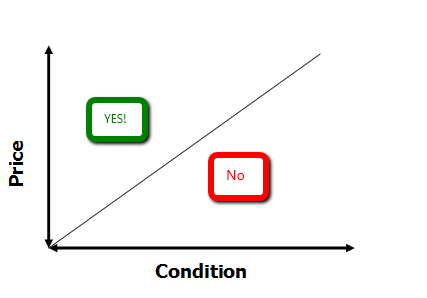
What I’d like to talk about today is being competitive in the market. The main variables a seller has control over is the price they ask for their home and condition and/or upgrades of the home. I have represented these two variables on an axis below so that I show you what I’m thinking. Basically, if your home is in great (and I mean exceptional) you can ask a high price compared to similar homes on the market. If your home is in poor shape you have to ask a lower price. This is not rocket science but it gets trickier when a house is somewhere between the extremes. It is in okay condition and has a middle of the road price. Looking at the chart below you can see the line running at 45 degrees. Think of this as the success line. Every house that fits above the line (price vs. condition) will most likely end up in a successful sale. Every home below the line will wallow until the price or the condition changes enough to get it above the line.
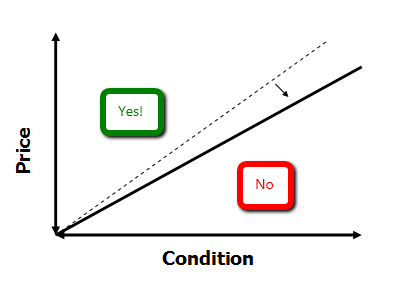 Right now the market is fairly slow. There are fewer buyers out there. This means that competition for sellers is tough. In order to be compelling to the small pool of buyers they have to bring a more compelling product to the market. This means that the line has shifted, sellers have to either improve their home to sell it for the same price or reduce their price to make it work.
Knowing where you are is the tricky part. I help my clients by giving good feedback and keeping them abreast of the market as it changes. The information you used to list your house is no longer valid. Get it priced right and have your house show the best it can. If you can’t afford to make improvements up front, lower your price. It’s simple economics.